




































 /SC-1600

 TOP
TOP


Vol.17 The Anterior Segment of the Eye
| The human eye is a small organ measuring approximately 24 mm in diameter. Nevertheless, it has a complex structure. The human eye can be large, small, upturned, or downturned. However, except in special cases, all adult eyes have the same structure and function. In this study, we introduced the anterior segment of the eye. | 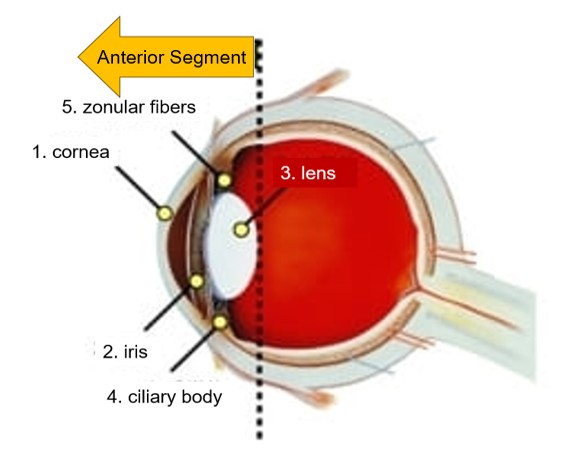 |
1. Cornea
The cornea is a thin, transparent membrane on the pupillary surface. Light from the outside gathers and bends its path to the eye.
2. Iris
The iris controls the amount of light that enters the eye. Light is transmitted through the pupil, which is located at the center of the iris. The iris adjusts the amount of light entering the eye by enlarging the pupil in dark areas and reducing its size in bright areas.
3. The lens
This lens is a transparent, tissue-shaped, convex lens that bends light. It becomes thinner and thicker when focusing on objects at a distance and close range, thereby allowing light to pass through the retina.
4. Ciliary body
The ciliary body protrudes behind the iris. From this surface, many thin threads (cingula) protrude and hold the lens in place.
5. Cingulum
The ciliary body stretches and contracts while fluttering to make the lens thinner or thicker. This function allowed us to focus on both distant and nearby objects.
All the above tissues are very small, but their functions work together to enable us to see things.
Back to List