


























 /SC-1600

 TOP
TOP


Vol.19 How Do We See?
| How does the human eye view objects? The structure of a human eye is similar to that of a camera. Let us introduce the “seeing mechanism” by referring to which tissues of the eye correspond to what of a camera. | 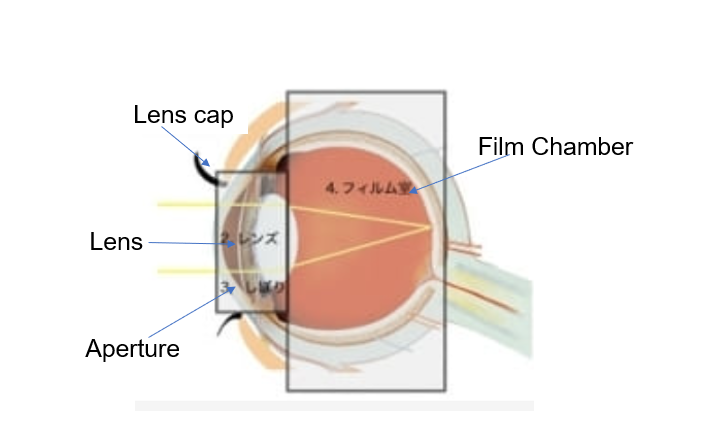 |
1. Eyelid
The eyelids serve as the lens cap and shutter. They protect the eye from dust and dryness and limit the amount of light entering the eye to prevent damage to the retina.
2. Cornea and lens
The cornea and lens work like lenses. The cornea also acts as a filter that absorbs ultraviolet rays. The phenomenon of light being bent by lenses and other objects is called “refraction.”
The camera is focused from far to nearby moving its lens. However, the eye has an autofocus function that “adjusts” focus from distant to near objects by thinning or thickening the lens. The thinnest state of the lens is called the “unaccommodated state.”
3. Iris
The iris acted as an aperture. This function adjusts the size of the “iris” and limits the amount of light entering the eye.
4. Vitreous
The vitreous acts as a film chamber. It maintains a constant distance between the lens and the retina and forms an appropriately sized image on the retina.
5. Retina
The retina acts as an image sensor in both film and digital cameras. In a digital camera, an image sensor converts incoming light into electrical signals, which are processed by a computer and recorded in memory. The brain is the computer that processes electrical signals, while the optic nerve connects the image sensor to the computer.
In this way, the eye and the camera have very similar structures.
Back to List