





































 /SC-1600

 TOP
TOP


Vol.22 Carnivores? Herbivores? ~The Wonder of Animal Eyes
| “Carnivores” and “herbivores”—terms that are often discussed these days— are animals that can be classified based on what they eat. Interestingly, their eye structures also differ significantly depending on what they eat. But how do their eyes differ from each other?
In this issue, we will introduce the eye structures and functions of “carnivores” and “herbivores.” |
Difference in eye position
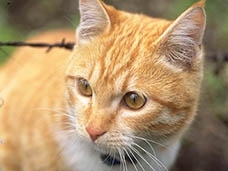
The cats were classified as carnivorous. Most carnivores survive by hunting and eating with other animals. If you look closely at a cat’s eyes, you will see two lines in a row in front of its face.
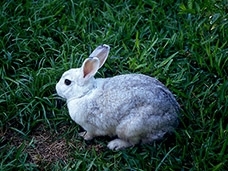
Rabbits are herbivores. Most herbivores eat grass and trees. If you look closely at the eyes of the rabbit, you can see two lines on the sides of its face.
Thus, the position of the eyes differed between carnivores and herbivores. Where did these differences originate?
Eye development of carnivores
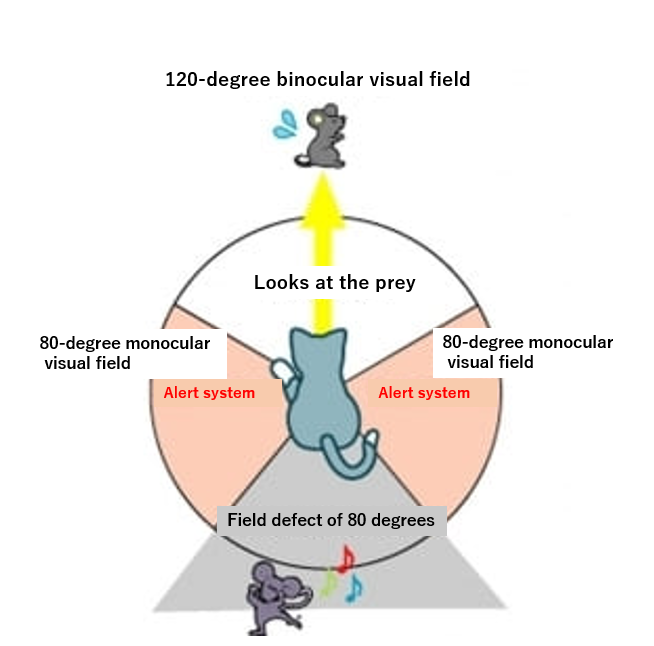 |
For example, how are the eyes of carnivores such as cats made? The figure on the left shows the visual field of a cat.
The characteristic point of a cat’s visual field is the 120° binocular field in front of the face. This binocular field of view is an area that can be seen in both eyes, allowing the cat to be seen in three dimensions. The binocular field of vision was wide enough to accurately measure the distance to the prey when hunting. In contrast, the monocular field of vision used to look around with one eye is only 80° left and right. The 80° angle behind the head is called the blind zone and is completely invisible to the eye. Thus, it can be said that carnivores evolved with two eyes in front of each other to be able to see a wider area in three dimensions and measure distances accurately. |
Eye formation of herbivores
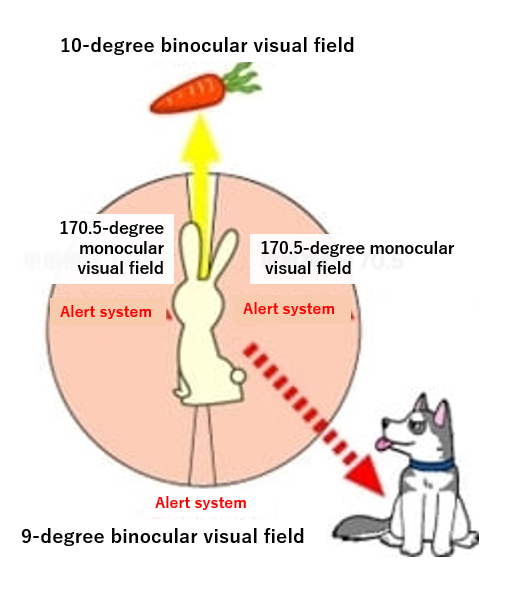 |
How are the eyes of herbivores such as rabbits constructed? The figure on the left shows the rabbit’s visual field.
The characteristic point of the rabbit’s field of vision was a 170.5° monocular field of vision on each side of the face. The monocular field of view is the area within which a rabbit can see its surroundings with only one eye. When this monocular field of view was combined with the binocular field of view in front of and behind the rabbit’s face, the rabbit could see 360° around itself. The rabbit used this 360° field of vision to quickly spot predators sneaking up and escape. In contrast, the “binocular vision” is 10° in the front and 9° in the back. The binocular vision used to catch prey is 10° in front of the face; however, surprisingly, rabbits also have binocular vision behind the face, which is used mainly to escape predators. Thus, herbivores have evolved to be able to see over a wider area by having two eyes side by side on their faces. |
What we have in common
You have seen that the eyes of the same animal can be very different depending on whether it is a carnivore or herbivore; that is, what it eats.
Recently, the terms “carnivorous” and “herbivorous” have become popular to describe different types of humans. The eyes are the same regardless of whether a person is a “carnivore” or a “herbivore.” Carnivores pursue their goals with a straightforward face, whereas herbivores have a good understanding of their surroundings. Their vision may reflect their behaviors and survival strategies.
Reference: “Science of Eyes” by Akira Neki, Bunkodo
Back to List